Wednesday, April 04, 2018

CSI Calvary

What happens when an atheist detective takes the skills he uses to solve cold-case murders and applies them to the resurrection of Jesus of Nazareth?
J Warner Wallace is a police and media sensation known for solving homicides whose trail has gone cold. It may have been decades since the crime was committed. There is little or no forensic evidence. There might be no surviving witnesses.
A cold-case investigator seeks out secondary witnesses who ‘can be evaluated in a number of ways to confirm their reliability,’ says Wallace. ‘In the end, a strong “circumstantial” case can usually be made by collecting witness statements and verifying these observations with what little forensic evidence is available. By taking this approach, I have arrested and successfully prosecuted a number of cold-case suspects who thought they had gotten away with murder.’
Wallace’s investigative work has received national recognition. He has featured as a cold-case detective on NBC’s Dateline, Fox 11 Los Angeles, CourtTV and truTV. He’s been awarded the Sustained Superiority Award – the Police and Fire Medal of Valour. In 2015, he won the California Peace Officer Association Award (COPSWEST) for the best-solved cold cases.
‘My friends knew me as an angry atheist, a sceptic who thoughtfully dissected Christians and the Christian worldview.’ J. Warner Wallace
In his bestselling Cold-Case Christianity: A Homicide Detective Investigates the Claims of the Gospels, Wallace writes: ‘My friends knew me as an angry atheist, a sceptic who thoughtfully dissected Christians and the Christian worldview.’ He was 35 when the gospels caught his attention as an investigator who had interviewed thousands of witnesses and suspects. ‘The most important questions I could ask about Christianity just so happened to fall within my area of expertise,’ he notes.
As an atheist, Wallace recognised that the most significant claim of the alleged apostolic witnesses was about the resurrection. He had always assumed that the resurrection was a lie, believing that the twelve apostles ‘concocted, executed, and maintained the most elaborate and influential conspiracy of all time’.
Wallace looked at the evidence provided by scholars ranging from sceptics to conservative Christians, and as an ‘unbeliever’ found four minimal facts to be substantiated ‘by both friends and foes’ of Christianity.
1. Jesus died on the cross and was buried.
2. Jesus’s tomb was empty and no one ever produced His body.
3. Jesus’s disciples believed that they saw Jesus resurrected from the dead.
4. Jesus’s disciples were transformed following their alleged resurrection observations.
Wallace had always assumed that the twelve apostles ‘concocted, executed, and maintained the most elaborate and influential conspiracy of all time’.
Of course, none of these ‘minimal evidences’ convinced him that Jesus rose from the dead. Wallace narrates how he then used the kind of abductive reasoning he would use at a crime scene ‘inferring the most reasonable explanation’. First, he would identify facts and pieces of evidence at the crime scene. Second, he would acknowledge a number of potential explanations that might account for what he and others observed.
Wallace used abductive reasoning to examine the events around the cross and tomb as an ancient death-scene investigation and came up with several hypotheses.
One: The disciples were mistaken about Jesus’s death. Jesus survived his crucifixion and appeared to disciples after he recovered. This theory fails to explain what the disciples saw when they brought Jesus down from the cross. Didn’t they check if he was breathing, if his body was cold or if rigor mortis had set in? Is it reasonable to believe that those who removed Jesus from the cross would have not noticed any of these conditions common to dead bodies?
Two: The disciples stole the body and fabricated the story of the resurrection. While this explanation accounts for the empty tomb and the resurrection stories, it fails to account for the transformed lives of the apostles. The apostles, who had been cowards, running ran away at every point of danger, were now suddenly as bold as a battleship because of the lies they themselves had concocted, even though they received no gain or benefit from the elaborate hoax.
Didn’t they check if he was breathing, if his body was cold or if rigor mortis had set in?
Three: The disciples were delusional. The appearances they reported were hallucinations based on wishful thinking. This fails to account for the empty tomb. More importantly, Wallace argues that he has never encountered loved ones who have collectively imagined an identical set of fictional events involving the victim. While individuals may hallucinate, we do not have examples of large groups having identical hallucinations.
Four: An imposter tricked the disciples, convincing them that Jesus was alive. This would require an additional set of con artists. While failing to account for the empty tomb, this theory requires a group of individuals who would be highly motivated to impersonate Jesus and fool the disciples. What would they gain? The disciples were highly sceptical and the impersonator would have had to be familiar with Jesus’s mannerisms and adept at copying them. Above all, he would have needed to possess miraculous powers since the disciples report Jesus working miracles after the resurrection.
Five: A couple of the disciples had a vision of Jesus and convinced others that Jesus had risen. ‘It’s not unusual to have a persuasive witness influence the beliefs of other eyewitnesses,’ concedes Wallace. ‘But the persuaded witnesses were easily distinguished from the one who persuaded them once I began to ask for their account of what happened.’ This theory does not account for the numerous, divergent and separate group sightings of the post-crucifixion Jesus in the gospels.
Six: The resurrection is a wildly exaggerated legend that grew exponentially over time. This theory clashes with the record of witnesses making claims about the resurrection from the earliest days of the Christian movement.
While individuals may hallucinate, we do not have examples of large groups having identical hallucinations.
Wallace concludes: ‘The resurrection is reasonable. The answers are available; you don’t have to turn off your brain to be a believer. Yes, it is possible to become a Christian because of the evidence rather than in spite of the evidence. Many of us have done just that.’
Wallace joins a long line of intellectuals who are part of the ‘resurrection genre' of writers – sceptics who started out to disprove the resurrection and ended up believing that it is true. You can watch him here.
Konrad Adenauer, the post-war German Chancellor, once asked Billy Graham: ‘Mr Graham, what is the most important thing in the world?’ Graham recounts, ‘Before I could answer, he had answered his own question. He said, “The resurrection of Jesus Christ. If Jesus Christ is alive, then there is hope for the world. If Jesus Christ is in the grave, then I don't see the slightest glimmer of hope on the horizon.” Then he amazed me by saying that he believed that the resurrection of Christ was one of the best-attested facts of history.’
Christos Anesti! Alithos Anesti! Christ is risen! He is risen indeed!
(Originally published in The Conservative Woman.


England's Test Cricket.
 Yet to prove himself as anything more than an average captain, Joe Root has most assuredly not been granted the most reliable of test squads with which to work.
Ironically, however, the two one day squads (in which he features) both look in far better shape.
Certainly, England are unlikely to be able to plunder the two squads from the shorter forms of the game as the majority of batsmen therein are simply incapable of making the move to the toughest of all forms of cricket.
England have had a very long antipodean winter and have lost five tests out of seven with just two draws as minor consolation. Yesterday, they came within an ace of taking the second test against New Zealand but were unable to capitalise on their advantage as time ran out.
A miserable tour which still leaves a number of questions over Root as captain.
Let us consider the current team. Alastair Cook - perhaps the greatest England opener since Geoff Boycott (and with a better average) now looks past it. The dedication, class and concentration are now distant memories.
England have long been seeking an adequate partner for him but the time has come to jettison Cook himself and look, not for one dependable open bat - but two!
This is thoroughly scary. Where can England find two men prepared to get their heads down and grind out huge scores?
I have no idea.
Certainly, Stoneman's string of good starts and yet, few big scores, has hardly cemented his place in the side. I can see no other county batsman worthy of anything more than a stop-gap position. This is a huge problem for the selectors.
In the middle order, Mo' Ali has proved dubious with the bat over the last year and his spin bowling, which made him a possible all-rounder, has let both him and England down.
Vince has been offered many chances but still seems no more than a fringe member of the squad who falls, far too often, in 'the corridor of uncertainty'.
Rashid, our leg-spinner - now bowling as well as at any time in his career - has opted out of the longer form of the game, very possibly because England failed to take him on the Ashes tour for reasons unexplained!
Jack Leach bowled well enough in NZ but is not the deadly spinner which England so desperately lacks - and has done since the enforced retirement of Swann - whose immaculate off-spin now seems to have become no more than a wistful memory. If Leach were good enough, England would definitely have cruised to victory in Christchurch, yesterday. Hopefully, he will develop.
Jimmy Anderson - England's top wicket taker of all time remains a superb bowler but surely Father Time is going to catch up with him very shortly and Stuart Broad is not all that much younger.
England have got by without a truly fast bowler for many years at the same time as so many other nations have seemingly got production lines for turning them out! But as this pair of medium quicks cannot be all that far from retirement, one or more must surely be found - and soon!
Overton and Roland-Jones look decent enough and are young enough to develop into good, test standard, medium quicks - but will they?
Certainly, Wood is not living up to my high expectations of him as probably England's quickest bowler. His injury record also fails to inspire confidence.
If we take Broad, and Anderson out of the equation - just how many out and out certainties are there for the England Eleven of the future?
Root, Bairstow and Stokes are the only ones which come to mind but hopefully Malan will build on this last year and make the grade. Just seven short out of eleven. I repeat, 'scary'!
So many gaps; so much weakness; so few test players coming through the system.
It is sad that England are getting it so very right in the 50 and 20 over formats but with players who simply fall sort of the quality needed to be test class.
With our weakest test team in decades, it make me wonder what damage the shorter form might have done to cricket in its highest form. In particular, batsmen are not learning how to build an innings: bowlers are not being encouraged to learn the virtues of line and length.
Tuesday, April 03, 2018
CS Lewis.
C.S.Lewis.
 I used to read the entire Narnia Chronicles every Christmas but had not done so for three or four years.
Being laid low with a nasty virus, I tracked them down, dusted them off and returned to my state of marvelling at the expertise of the great professor.
Every major biblical doctrine is covered across the seven volumes - and in terms which may be understood by all. I shall refer to some of these in future postings.
Today, I look at Lewis the incredible social commentator. The Last Battle was first published over 60 years ago and yet he predicted the odious multifaith attitudes which would develop. In giving you a passage from that book, I must explain that the lion Aslan is the equivalent of Jesus and Tash represents all false gods; demons and even Satan. The manipulation of ordinary people's thinking is identical to today.
"We know better now. {They} use different words but we all mean the same thing. Tash and Aslan are just different names for you know Who. That's why there can never be any quarrel between them. Get that into your heads you stupid brutes.Tash is Aslan: Aslan is Tash."Later on, the forces of evil combine the two into TASHLAN.
".....there is no such person as either...all who are enlightened know that" say two of the conspirators at a later time in the book.
Sellout merchants; deceivers; fifth columnists; so-called liberals are all granted licence by the apathetic to combine together to bring down a society from its very base.
I thought he was just a brilliant writer but no - he wrote prophetically and with Orwellian accuracy.
BBC Bias.
UKIP Wales Leader files complaint against BBC programme for "anti-Brexit bias"
Published Mar 20, 2018
UKIP Wales Leader Neil Hamilton has written a complaint to the BBC and Ofcom about a segment of the BBC Radio 4 programme The World at One. The UKIP Wales Leader criticised the “anti-Brexit bias” of the programme.
The segment, broadcast on Monday 19 March involved BBC journalist Tomos Morgan asking children from Pontybrenin Primary School near Gorseinon about their views on Brexit.
The segment, broadcast on Monday 19 March involved BBC journalist Tomos Morgan asking children from Pontybrenin Primary School near Gorseinon about their views on Brexit.
The complaint in full:
"I am writing to complain about the segment on the World at One which involved Wales correspondent Tomos Morgan asking children from Pontybrenin Primary School near Gorseinon about their views on Brexit.
"I am writing to complain about the segment on the World at One which involved Wales correspondent Tomos Morgan asking children from Pontybrenin Primary School near Gorseinon about their views on Brexit.
The segment was completely biased and absurd. Every child who featured on the programme was anti-Brexit and the segment lacked any form of political balance.
The interviewer, Tomos Morgan, failed to question any of the patently childish answers given to him. If the BBC’s role is to educate, then all this segment did is prove how ridiculous it is to pose high-level political questions to nine-year-olds. It was a mawkish puff piece, playing on the emotions of the listener in order to support the Remainer narrative that the nasty Brexiteers are stopping our children from being able to play with their friends from abroad.
According to a Brexit survey by TES in 2016, 75% of teachers supported remaining in the EU. Given this fact, the dangers of bias and indoctrination in the classroom are high, even if done unconsciously. There was no mention of these studies in the reporting or any angle of criticism for the proposals.
What is the BBC doing to challenge the Welsh Government’s plans to question children as young as seven about their views on Brexit? The journalist should have asked Children's Minister Huw Irranca-Davies about this policy and presented a balance of arguments for him to answer. By asking children questions about Brexit, the BBC is tacitly supporting the policy of the Welsh Government while providing no arguments against it. The programme demonstrates an abject failure to support the BBC’s editorial guidelines on due impartiality."

Nick Summarises Brexit.
From: Nick Martinek, Briarlyn Road, Huddersfield. Apparently we aren’t capable of governing ourselves any more, so we need the EU to look after us. Or so Remainers tell us. Their propaganda is false, of course, but self-serving. It lends a veneer of respectability to otherwise worthless EU bureaucracy, and disguises the really dangerous EU empire building. It is typical of the EU: the pretty public face is provided to satisfy gullible Remainers, but what’s really going on is hidden. Under the surface, the EU is institutionally corrupt. The recent emergence of Martin Selmayr as Secretary-General of the of the European Commission illustrates EU corruption perfectly – it was without due process, and sweetened by pay-offs to retiring Commissioners. Leading figures in and around the EU such as Christine Lagarde, Jean-Claude Juncker and now Nicolas Sarkozy are tainted by corruption. Thank God we are leaving this cesspit.
Read more at: https://www.yorkshirepost.co.uk/news/opinion/yp-letters-why-does-mp-have-burned-eu-flag-online-1-9083880
Read more at: https://www.yorkshirepost.co.uk/news/opinion/yp-letters-why-does-mp-have-burned-eu-flag-online-1-9083880

Monday, April 02, 2018
Anti-Semitism Costing Labour?
17,000 members quit Labour over anti-Semitism row: Pressure grows on Jeremy Corbyn as he DELETES his Facebook account and TWELVE party staff are revealed to be in vile hate groups.
http://www.dailymail.co.uk/news/article-5567155/Corbyns-inner-circle-dragged-anti-Semitism-row.html
Resurrection!
Just a happy ending? Examining the evidence for the resurrection.
Even some Christians may have their doubts about the historicity of the story. In a highly rationalist, post-enlightenment culture, professing faith in a resurrected rabbi might just sound silly.
Yet, Christian apologists frequently centre on Jesus' 'empty tomb' not only as an essential theological tenet, but as one of the most secure platforms from which to make the case for faith. Hence the success of evangelistic books like the bestselling Who Moved The Stone? On a grander scale, academic tomes like New Testament scholar NT Wright's The Resurrection of the Son of God have examined the miracle and its 1st-century meaning.
So what is the evidence for the resurrection? It's a vast conversation to sum up, but there are at least three key points to engage.

1. The honest evangelists
The first assumption made about the resurrection is that it was just a fanciful legend added to the Jesus story long after his life and long after it could be clearly contradicted. And since miracles don't happen, what we can interpret from the stories of Jesus' return is rather a spiritual meaning: though Jesus died a terrible death, he 'lives on' in human hearts. Yet, the resurrection in the New Testament is not a ethereal, non-bodily event but a jarringly tangible experience: the Christ of Easter morning is seen and touched by many. Moreover, it is the central drama of Christ's story, told in all four gospels and preached passionately by Paul.
The significance of Paul's writing is key: though the written gospels emerged decades after Christ, Paul writes no more than 20 years after. In 1 Corinthians 15:3-6 he notes the resurrection not only as a central dogma of the early Christian creed, but speaks of Christ who 'appeared to more than five hundred of the brothers at the same time, most of whom are still living, though some have died'.
This mention in his letter stands as an implicit corroboration and invitation. Jesus was seen by many, Paul says, and you could even go and meet these people. If you wanted to invent or control the story you could simply say that Christ appeared to only a few, and they're dead now so don't worry about the evidence. Similarly, the Gospel writers evidence their authenticity with details that might make their story look less convincing, but which they included anyway. Every Gospel writer states that the resurrection was first discovered by women. But at the time, social prejudice was such that a female witness was not legitimate evidence in court. Hanging your central dogma on the testimony of women was at the time daring to say the least. Unless of course it was true, and enough people knew it to be that you couldn't say otherwise.
2. The empty tomb
The witness of early Christian writings wold of course mean nothing without another key historical detail: the empty tomb. The Romans had just put to death a subversive, high-profile criminal: if his energetic, insurrectionist followers were suddenly declaring a return form the dead, it would be pertinent for the authorities to quash such claims, and simply produce the dead body they had entombed. But it never happened. Indeed, it would have been absurd for Christians to preach a bodily resurrection if their claim could be so easily contradicted. The tomb stands empty, so where did the body go?
Some have suggested that the disciples stole the body: not only would they have had to take on the Roman guard at the tomb, but they would need to forever preserve the dark truth that the defeated saviour they were suddenly declaring 'alive' had really just been shuffled elsewhere, while later dying for their faith. Wright's historical analysis is also clear that bodily resurrection, even of great religious leaders, was simply not an expectation of 1st-century Jews. It wouldn't be something you make up, let alone convince thousands of.
3. The explosive church
The despondent disciples on Holy Saturday are the picture of followers who have just watched their supposed-Messiah executed by the authorities they thought he would overthrow. Such a public humiliation and disappointment would prompt fear, not fervent faith. Yet history documents that this obscure Jewish sect did not die with that generation but exploded in an unprecedented way, becoming the faith still claimed by billions today.
And it was a faith that made strange claims contrary to the Jewish culture of the day: a bodily resurrection that promised future restoration, a man worshipped as the one God who made the world. As Tim Keller writes: 'After the death of Jesus the entire Christian community suddenly adopted a set of beliefs that were brand-new and until that point had been unthinkable.' Why would this movement flourish at all, let alone expand so rapidly, if built on a shaky and ludicrous hoax and backed just by a handful of fishermen? On the contrary, if a shocking yet undeniable, tangible and transformative resurrection really had taken place, and had been witnessed by hundreds, the inspired early church starts to make more sense.
No one can really be argued into faith, nor should we try to do so, and it's worth remembering that even a historically compelling case for Christ's resurrection might leave many unconvinced. The miracle may just remain too strange, too outrageous. But the historical case is good, important to state because it gets beyond the notion of resurrection as simply a 'happy ending' invented by the church. It helps get beyond assumptions and engage with what really might have happened.
But ultimately, what's at stake in this debate is not a detail of history, but the nature of reality: whether death has the final word on existence, or if hope endures and transcends even that one certainty of life.
It was a radical thought then; it's no less radical now.
You can follow @JosephHartropp on Twitter. CP.
Brother Andrew.
God’s Smuggler
Brother Andrew with John and Elizabeth Sherrill
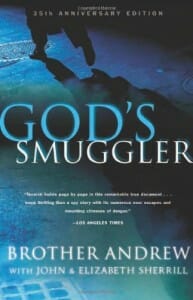
A classic of missions and the miraculous, Brother Andrew recounts his remarkable life of Bible smuggling behind the Iron Curtain. After being wounded in the foot as a Dutch soldier, Andrew was converted and ventured dangerously into many Communist countries at the height of the Cold War.

Redwood.
Brexiteer MP's brilliant response shows how single market DESTROYED British industries
A BREXITEER MP has delivered a scathing attack on the impact of the single market and customs union on Britain, saying that in the past 45 years there has been no evidence of a boost to growth. John Redwood, an arch-Brexiteer, spelt out why Britain is better outside of the EU in an incredible response this morning.
The MP was asked by Sky News anchor Niall Paterson to put forward his best arguments for leaving the EU, which he used to remind voters why Brexit remains worth it despite the struggle.
Mr Redwood railed against the damage that membership of the EU had done to the UK, naming the annual payments of billions, as well as destructive fishing policies.
Health Tourism From EU Alone!
Health tourism gap REVEALED: Soft touch UK pays out £565m MORE than EU nations send.
BRITAIN paid European governments nearly £565million more last year to treat UK citizens abroad. Express.

Brexit MORE important than keeping Northern Ireland within UK – poll.
Brexit MORE important than keeping Northern Ireland within UK – poll.
MORE voters in Great Britain rate leaving the EU as a priority ahead of maintaining the Union with Northern Ireland, a poll has suggested. More than a third of those polled (36 per cent) said exiting the European Union was a higher priority than keeping Northern Ireland within the UK.
Of those surveyed, 29 per cent said retaining Northern Ireland within the UK was more important than Brexit.

Mmm. Let's Rip Off The Sick!
I don't see why people are applauding this. With coeliac disease, paying a few % extra to reflect production costs is one thing. 300% extra implies Tescos OR Goodfellas taking advantage of people for being sick. Reasonable for customer to try to find out which is ripping them off.
Subscribe to:
Posts (Atom)
.jpg)

