Girolamo Savonarola | |
|---|---|
| De facto Ruler of Florence. Wiki. | |
| Reign | November 1494 – 23 May 1498 |
| Predecessor | Piero de' Medici |
| Successor | Piero Soderini |
| Born | 21 September 1452 Ferrara, Duchy of Ferrara |
| Died | 23 May 1498 (aged 45) Florence, Republic of Florence |
| Cause of death | Execution |
| Father | Niccolò di Michele dalla Savonarola |
| Mother | Elena Bonacolsi |
| Signature |  |
Having made many powerful enemies, the Dominican friar and puritan fanatic Girolamo Savonarola was executed on 23 May 1498.
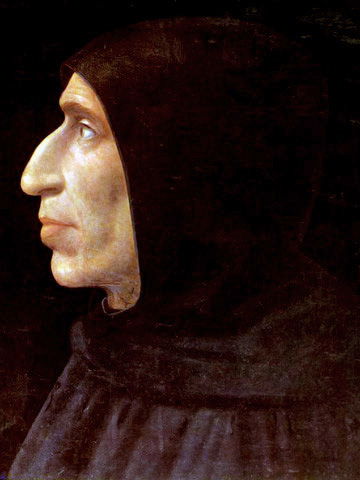
Girolamo Savonarola
Girolamo Savonarola, Dominican friar and puritan fanatic, became moral dictator of the city of Florence when the Medici were temporarily driven out in 1494. Sent to Florence originally a dozen years before, he made a reputation for austerity and learning, and became prior of the convent of St Mark (where his rooms can still be seen). A visionary, prophet and formidably effective hellfire preacher, obsessed with human wickedness and convinced that the wrath of God was about to fall upon the earth, he detested practically every form of pleasure and relaxation.
His opponents called Savonarola and his followers ‘Snivellers’ and he grimly disapproved of jokes and frivolity, of poetry and inns, of sex (especially the homosexual variety), of gambling, of fine clothes and jewellery and luxury of every sort. He denounced the works of Boccaccio, nude paintings, pictures of pagan deities and the whole humanistic culture of the Italian Renaissance. He called for laws against vice and laxity. He put an end to the carnivals and festivals the Florentines traditionally enjoyed, substituting religious festivals instead, and employed street urchins as a junior gestapo to sniff out luxurious and suspect items. In the famous ‘bonfire of the vanities’ in 1497 he had gaming tables and packs of cards, carnival masks, mirrors, ornaments, nude statues and supposedly indecent books and pictures burned in the street. The friar also disapproved of profiteering financiers and businessmen.
Not surprisingly, Savonarola made many powerful enemies. Among them was the Borgia pope, Alexander VI, who had good reason to feel uncomfortable with the Dominican’s denunciation of the laxity and luxury of the Church and its leaders, and who eventually excommunicated the rigorous friar. On Palm Sunday in 1498 St Mark’s was attacked by a screaming mob and Savonarola was arrested by the Florentine authorities with two friars who were among his most ardent followers, Fra Dominico and Fra Salvestro. All three were cruelly tortured before being condemned as heretics and handed over to the secular arm by two papal commissioners, who came hotfoot from Rome for the purpose on 19 May. ‘We shall have a fine bonfire,’ the senior commissioner remarked genially on arrival, ‘for I have the sentence of condemnation with me.’


.jpeg)