Self explanatory title. I abhor that nicey nicey, politically correct, pseudo-Christianity which almost always supports leftwing attitudes - which in most cases are profoundly anti-Gospel. This Blog supports persecuted Christians. This Blog exposes cults. This Blog opposes junk science. UPDATED DAILY. This is not a forum.
This Blog supports truly Christian websites and aids their efforts.
It is hardhitting and unashamedly evangelical so if it offends - please do not come to this site!
The government is consulting on draft guidance for Independent Schools which threatens to prevent teachers from saying that they disagree with same-sex ‘marriage’.
The standard will not be met if, for example, the PSHE curriculum: … c. suggests that same-sex marriages or civil partnerships should not be recognised as being lawful unions under civil law;
A plain reading of this wording would restrict the free speech of teachers in schools so that they can not suggest that same-sex ‘marriage’ should not be legal. It is possible that the government intends another meaning, but if so the government needs to tighten the wording of this clause. Christian Concern.
£11+ for a 90-second phone call to 118 numbers? Turns out it's EU Directive 2002/77/EC that caused this mess, then the Commission said 'we didn't force 118 on you' - meaning we could've chosen 117 or 119 if we preferred. Retweet to spread the word!
Cricket collapse: Peterborough Town take seven High Wycombe wickets in 11 balls
By Frank Keogh
BBC Sport
From the section
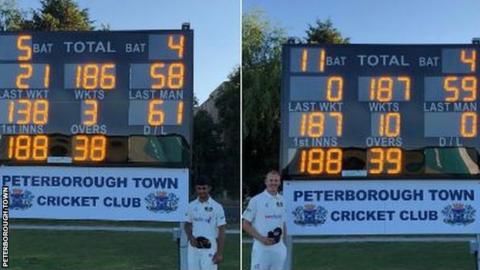
Before and after: Peterborough players Danyaal Malik and Kieran Jones with the scoreboard
Surreal. Incredible. Embarrassing. Some of the descriptions for a remarkable cricket turnaround.
Needing just three runs to win off the final two overs, at 186-3, High Wycombe were easing to victory and the last 16 of the National Club Championship.
But a spectacular collapse ensued - all out for 187, losing seven wickets in 11 balls to opponents Peterborough Town.
A four-wicket maiden was followed by three more dismissals in the final over, courtesy of the sixth-choice bowler, an off-spinner aged 16.
"It was quite incredible. It didn't really sink in for a while. All the lads couldn't really believe it," winning Peterborough captain David Clarke, 29, told BBC Sport.
On February 29, 1948, Romanian pastor Richard Wurmbrand was arrested on his way to a church service. His 'crimes' were leading Christian worship and witnessing to his faith, both of which were illegal under the Communist regime. He was to spend 14 years in prison, undergoing torture and abuse. His wife Sabina was also imprisoned and brutally treated. This is a second extract from an inspiring new biography.
On a night in 1948 in the Calea Rahovei prison, at 10 pm, three guards burst into Richard's cell and demanded he get dressed. One of the guards named Appel strapped blacked-out goggles over Richard's face and led him through a long corridor to a room containing a table and a spotlighted chair.
As Appel removed the blindfold, Richard squinted into the light. The silhouette of a man across the table came into focus. Seconds later his face materialized, and Richard recognized him as Moravetz, a former police inspector who had recently been promoted to conducting interrogations.
Voice of the MartyrsRichard Wurmbrand
'You'll find paper and pen on that desk,' Moravetz said. Take your chair over and write about your activities and your life.'
Richard complied.
'As a priest,' the inspector continued, 'you've heard any number of confessions. We've brought you here to confess to us.'
For the better part of an hour, Richard scribbled down his story, covering the major milestones of his spiritual biography. Like his interrogators, Richard also had once been an atheist before his heart was changed.
'That's enough for tonight,' Moravetz finally said, confiscating Richard's pencil.
After numerous similar interrogations, Richard soon learned his captors' methods and strategy. Instead of using police tactics that capitalized on the shock of arrest to glean confessions, the Communists preferred a much more patient approach – the prisoner must ripen first. The goal was to create enough guilt and anxiety to extract information gradually. Prisoners were rarely told why they were arrested, which threw them into a state of self-examination and uncertainty. Endless tricks created tension, doubt, and fear in their minds. Fake trials were scheduled and then postponed at the last minute. Firing squads were simulated in the courtyard outside the prisoners' cells. Tape-recorded screams and random shouts were played throughout the night.
After weeks of psychological games, resistance became more challenging. The mind began to break. Exhausted and guilt-ridden, the prisoner made false judgments, and one slip of the tongue became two. Names were given, friends betrayed. Before long, the interrogator had extracted the confidential information he sought.
Just before the mental breakdown, the interrogator switched his attitude and grew sympathetic to the prisoner's plight. Intimidation morphed into mercy. Promises were made to end the suffering, but only if the prisoner admitted guilt and confessed to his crimes.
Several days later, Richard was again retrieved from his cell and taken to a basement where two interrogators waited. Appel reached into his briefcase, removed a piece of toffee, and handed it to Richard.
'What were your connections with Mr Teodorescu?' Appel asked casually.
'Teodorescu? That's a fairly common name. Which one do you mean?'
Appel didn't explain but quickly switched topics, asking questions about the Bible and the prophecies of Isaiah about the Messiah. He acted interested in Richard's perspective, nodding and raising his eyebrows. Then, at random and without warning, Appel inquired about the names of those who assisted Richard in distributing Christian literature to Soviet soldiers. Had they heard about the prophecies of Isaiah? Appel listened politely, more interested in Richard's reactions than his words.
The next interrogator, an insecure little man named Vasilu, was less cordial. 'Write down the names of everyone you know,' he demanded. 'Tell where you met them and what your relations with them were.'
Richard hesitated, careful and selective in the names he listed.
'Don't pick and choose,' Vasilu snapped. 'I said everyone.'
Richard included names of Communist members of parliament and every random traveller he knew. If he accidentally surrendered the names of Christian ministers, their families would be arrested and savagely beaten.
'Question number two is to say what you have done against the state.'
Richard looked into Vasilu's eyes. 'What am I accused of?'
Vasilu slammed his fist on the table. 'You know what you've done! Get it off your chest. Start by telling us about your contacts with your Orthodox colleague Father Grigoriu and what you think of him. Just write, and keep writing!'
Richard reeled off as many chapters from his spiritual biography as the interrogators liked. On other matters, he revealed as little as possible.
Richard was interrogated for weeks with little sleep. At night he calmed his conscience by repeating Scripture verses embedded in his memory.
God also sent small encouragements, like the barber who whispered that Sabina was doing well and was continuing the ministry work. Knowing his wife was okay provided double doses of strength. Richard could endure the interrogations, but the thought of Sabina being questioned and tortured was too much for any husband to bear. If Sabina were arrested, what would happen to their son
Mihai? Countless children had already suffered that fate. He'd be orphaned and forced to live on the streets.
On one evening as he was trying to doze, the sound of a woman's sobbing voice emerged from a nearby cell. 'No, no!' she pleaded. 'Please don't beat me. Not again! I can't take it!' The corridor echoed with shrieks as the guards beat the woman senseless.
Richard listened intently until his eyes widened in horror. It was Sabina's voice! She had been captured and brought to Calea Rahovei. Richard spent the night weeping and crying out to her in the darkness. Could she hear him? What were they doing to her?
Richard later learned that the woman's voice was not Sabina's but only a tape recording that was played for every prisoner, each thinking the sound belonged to his wife, girlfriend, or mother.
* * * * *
The promise Richard had made to Sabina – that he would kill himself before betraying his friends –occupied his mind night after night. He remembered reading about a woman in the early church who had killed herself rather than lose her virginity to the barbarians who pillaged her monastery. If the church had canonised her, God could forgive Richard if his suicide rescued others from being slaughtered.
But the prison had confiscated his shoelaces. His cell was frequently checked for glass shards, cords and razor blades. The doctors gave him one sleeping pill every evening, but the guards always checked Richard's mouth to make sure he had swallowed it. Perhaps if he could hide the pill under his tongue, though, he could amass a small collection. To hide the salvaged pills, Richard stored them in the straw mattress, tearing a few stitches to open it. Within a month, Richard had collected thirty pills – more than enough to make him sleep forever.
Suicide gave Richard power over his adversaries, but the sounds of the city begged him to reconsider: a young girl singing, a tram car squealing around the corner. Richard had dedicated his life to serving God. Was it wise to end it?
The interrogators shined lamps in prisoners' eyes to unsettle them, but God had his own lights too. One evening Richard peered into the midnight sky and saw a single star burning in the blackness. The light of the star had travelled across the whole universe to console him. Perhaps his life could also travel great distances to reach future prisoners suffering for the Saviour. The star begged him to keep living, but Richard was still unsure. Maybe his death would do more good than his life.
The next morning the guards raided his cell and took the straw pallet to another prisoner. Richard's plans for suicide were suddenly thwarted. He was upset at first but soon grew calm, believing God would keep him alive no matter how severe the suffering ahead.
Wurmbrand: Tortured for Christ - The Complete Story is published by David C Cook, price £9.99. Christianity Today.
While biblical scholars debate whether it is biblically OK to drink alcohol, there is a widespread perception that it is good to drink alcohol for health reasons. Drinking red wine in moderation, and more recently alcohol, in general, has been advanced as something that can improve one's health. The constant messaging from the alcohol industry has people feeling they must drink two glasses of wine a day to feel healthy. This is a dangerous myth. Read more: https://www.christianpost.com/voice/dont-believe-the-lie-alcohol-is-not-a-health-food.html
Well, now. The Aussies were roundly beaten by 28 runs at Edgbaston last night with England firing on all four cylinders. A blistering, record-breaking half century from Jos Buttler and some mean hitting from Jason Roy led the way to England making a phenomenal 221. 28 runs is a large margin in this form of the game and the Aussies had opener Aaron Finch to thank that the gap between the sides had not become a chasm. White ball cricket against the visiting Indian side will be much tougher but England are certainly looking world class in both T20 and ODI cricket. (The embarrassment in Edinburgh now seems a long time ago.) The worries come in the more important form of the game, Test Matches, where England look badly undercooked. Buttler has successfully straddled the different types of cricket but far too many others seem incapable of doing so.
I despise these catch-all terms because: they are without definition; they mean different things to different people; the dates are so fluid as to be wholly guesswork. Utterly pointless!
If you should ever find me writing in this vein or using such expressions - please assume that there is, somewhere, a tongue firmly wedged in cheek!
The Church isn't serious about evangelism. But this new tool is bringing hundreds to faith.
18th April 2018
Don't outsource evangelism to the 'experts', says Jeremy Marshall
In 1914 Britain was completely unprepared for a major land war.
A tiny British Expeditionary Force (BEF) of six infantry divisions was cobbled together at the last minute and sent to France to try and stop the mighty German steamroller sweeping west. Fortunately, a French army of roughly comparable size to the Germans was able to halt the German advance.
But by the time the decisive victory was achieved in 1918 the British Army had over 6 million men under arms. Britain had finally mobilised its resources and achieved victory, albeit at a huge cost.
We face a similar challenge regarding evangelism in our country to that of Britain in 1914. We are trying to carry out the Great Commission but we are simply not serious. We are only using a tiny fraction of our God given resources. Many Christians feel its wrong or hopeless to share our faith and even those who are trying to carry it out often don’t know how.
Let’s be honest, how much of their time do our full time church workers put into evangelism? Their time tends to be more internally focused. Yes, they may run courses such as Alpha and Christianity Explored. They may also preach evangelistic messages, but how many non Christians actually hear them?
The burden of evangelism instead falls onto our BEF - a tiny handful of overworked evangelists to whom we have effectively outsourced the Great Commission. Yet Jesus’ orders are to all of us, not just the professionals.
18 months ago I discovered a wonderful new tool which has proved incredibly effective in helping me to be equipped to share my faith. I believe it could be a game-changer for us in the battle to save souls. It's called The Word One to Oneand the concept is very simple.
You begin by simply inviting your friend to have a chat about the Bible. If they agree, you find a convenient location, sit down with a copy of The Word One to One notes, open John's gospel and off you go. I have found it an amazingly powerful tool which has been transformational for many of my friends. I've had 15 friends join me in this process of studying the Bible over the past 18 months.
One friend of mine invited someone to look at John's gospel because he thought it would be comforting after the death of his friend’s wife. The man eagerly accepted, without saying that his daughter, living 4000 miles away, was doing the same thing with another Christian and had just said to her father that she was finding it very comforting!
The use of Word One to One has spread like wildfire throughout the world and it’s been used in countless churches. It mobilises potentially every Christian, but it works most of all because it’s Gods appointed means to reach lost humanity. John himself told us “These are written that you may believe that Jesus is the Messiah, the Son of God, and that by believing you may have life in his name.” (20:31)
The Bible itself is full of one to one Bible work - Philip with the Ethiopian eunuch and the Lord himself on the road to Emmaus.
When our friends read the Bible something supernatural happens - God himself steps off the page. When they read John they read about a series of encounters the Lord has with men and women and how they come to believe that he is the Saviour of the world. By the power of the Holy Spirit the same thing happens.
A friend of mine led someone to faith using the notes and asked him what it was that he had said that impacted him. “To be honest“, came the reply, “I can’t remember a single thing you said, but John had me at ‘In the beginning was the word’. I suddenly thought to myself ‘You are a fool. Dawkins is wrong, there has to be a beginning. John went on to tell me who that Word was and what he had come to do. It was nothing you said, it was the Word.”
It also works because it’s a low threshold for our friends to step over. In a biblically ignorant age, asking our friends to come to church is a high hurdle to climb over. A professional that they don’t know, speaking in a place where they feel very uncomfortable, surrounded by unknown people singing songs they don’t know, at a time that may not suit them, can be a high barrier. But The Word One to One takes a person through the gospel at his or her own pace and builds knowledge of God slowly and surely.
God calls each of us to stand up, be mobilised and share our faith. We are not all Bible teachers but we are called to be Bible sharers.
Jeremy Marshall is a banker, charity trustee, Watford FC fan, blogger and speaker
For more information about The Word One to One visit theword121.com
SCRAP THE LORDS: It’s time to STOP peers 'thwarting the will of the British people.'
CALLS to replace or scrap the House of Lords have intensified amid ongoing attempts by some peers to derail Brexit. Senior Labour MP Frank Field tabled a Bill in the House of Commons calling for the Upper House to be replaced by a much smaller "senate" with limited powers to delay or amend legislation.
LET me first apologise if I depress you on the eve of my birthday. But, as I near 86, I really do wonder why I have come to live in such in such a guilt-ridden and endlessly emoting country that is irrationally going to the dogs. Where have we put our self-confidence, common sense and stiff upper lip? Of course, Sir Vince Cable, leader of the Liberal Democrats, will say that I have lost my marbles – if only because I voted wholeheartedly for Brexit. But what is so wrong with wanting to govern ourselves instead of losing our identity and being sunk forever in some undemocratic European lump? What is so wonderful about the EU? Why do some people feel guilty about leaving it? After two world wars and a proud Cold War role, we owe mainland Europe nothing. They owe us – and the Americans – their liberty. Iceland & Land of the Northern Lights £988 Promoted by iglucruise.com You would not think that from the persistent denial by Remainers of the very logic of their position – that they are the EU’s fifth column trying to block the expressed will of the people. It would serve them right if, post-Brexit, they were banned for life from public office. After all, they are destroying the Mother of Parliaments. Why should anyone bother to vote any more since our much-vaunted Westminster democracy has been usurped by Brussels? Then there is immigration, which has the capacity to end our – and Europe’s – liberal culture. We are now, it seems, to admit more skilled workers at a time when most people think immigration has gone too far and has left us with severe problems – in housing, education and health resources, our security and our identity. You may well argue that we should admit those who would help to drive the economy. I find it difficult to disagree with that, even though it is clear that some Britons won’t soil their hands with dirty jobs. But we have only the vaguest idea of the true level of immigration since we do not know how many illegal immigrants remain within our borders. And why do we need to admit more foreign doctors when the latest figures show that four out of 10 of our own doctors quit after five years, either to serve as well-paid locums, ply their trade overseas or wash their hands of medicine? I am not surprised. Our long 10-year training and exploitation of young doctors is not calculated to keep them in the NHS, which is now to get a £380m a week 70th birthday Brexit bonus without a clear plan for drastic reform. That is just throwing good money after bad at a time when giants of industry such as Rolls-Royce are thinning out their managerial layer. Why doesn’t the NHS decimate (at least) its over-paid executive deadweight, bearing in mind its continuing crises over bed-blocking and waiting lists and such scandals as hospital car park charges? And then, to cap it all, we have the Church of England about to debate – again – whether we should have a nuclear deterrent. Why do they feel so guilty about spending money on the one thing that has kept world peace for well over 70 years? After all, Vladimir Putin has recently acknowledged that a nuclear war would bring the end of civilisation, assuming he knows what it is. Recognising that, he is not likely to chuck nuclear bombs about. He wants a future even if the bishops and archbishops don’t. But that brings us back to guilt. Because of our elite’s bad conscience over our condition and history, they are no doubt at one with those who want to destroy many, if not all, vestiges of our glorious past. Yet, in the process, this guilt will see the end of formal Christianity in Britain, the very foundation of our liberal democracy. It is not enough to say that Europe as a whole suffers from these potentially fatal notions. It would be surprising if they didn’t, given that our Europhiles want to remain within the Brussels fold. The 2016 referendum was, at root, a demonstration that the ordinary men and women of this country think it is high time our politicians put their guilt, wetness and capacity for caving in behind them and started acting in the country’s interests. The best birthday present they could give me would be to stop, think where their wetness is leading us and take a hard-headed approach to our many societal ills, instead of committing suicide. Action this day, Mrs May.




.jpg)

