
|
|


This month, Answers in Genesis–US Founder CEO, Ken Ham, and Executive CEO, Martyn Iles, completed a sellout tour at arenas in 4 cities across Australia, reaching around 10,000 people. We now look forward to welcoming them to the UK and we don't want you to miss out - Let's fill Bethel Convention Centre and show them that the UK will stand with them, UPHOLDING THE TRUTH!
Joining Ken and Martyn from the United States will be theologian, Dr. Joel Beeke, and our own international speakers based here in the UK (Prof. Stuart Burgess, Prof. Andy McIntosh, Prof. Steve Taylor, Dr. Nagy Iskander, Joseph Hubbard, Pastor Pooyan Mehrshahi and AiG UK Director Simon Turpin) - with these you have a world-class line-up of scientists, researchers and Bible teachers.
How Christian women are standing firm in the face of persecution.
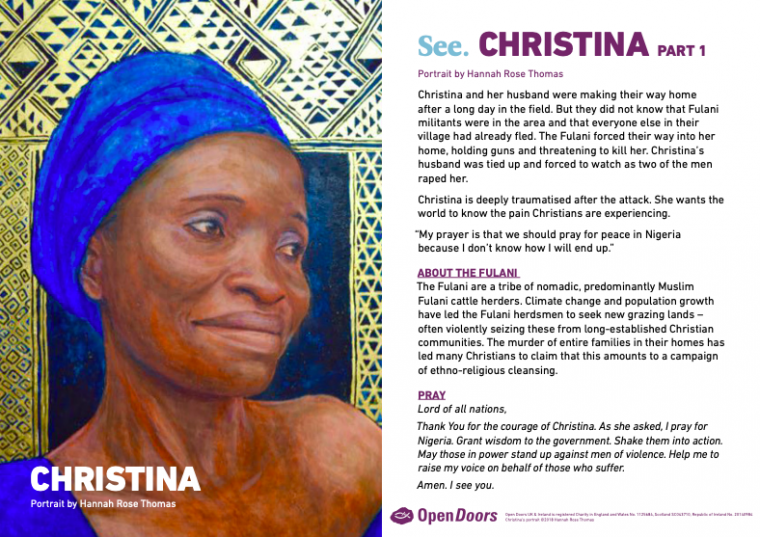 The Tears of Gold exhibition by Hannah Rose Thomas, sponsored by Open Doors, shows portraits of persecuted Christian women in Nigeria.(Photo: Open Doors)
Around the world, ordinary Christian women are suffering and being mistreated for no other reason than their faith. Christian Today speaks with Henrietta Blyth, CEO of charity Open Doors, to hear about the unshakeable faith of the persecuted Christian women they serve and how God has been working through the organisation.
How has God been using Open Doors to reach out to persecuted women?
Open Doors exists to strengthen the Church in the places where Christians face the most severe persecution and discrimination. We do trauma counselling to help people with traumatic experiences they may have had. We also connect the persecuted Church with churches in less persecuted countries like the UK and Ireland and we ask people here to speak out on behalf of our persecuted brothers and sisters to bring pressure to bear on our own MPs. The MPs in turn can influence and bring pressure to bear on their peers in other countries. We also pray because this is a spiritual battle and it will be won through prayer.
The women Open Doors support are being persecuted for their faith. Has their faith even been shaken given their circumstances?
There is an easy way to stop the persecution - just stop being Christian - and lots of these women are really pressured to give up Jesus. My experience from the women I have met is that despite what they have faced, it has actually strengthened their resolve to follow Jesus, and lots of them have had an extraordinary personal experience of his presence as well.
What is the greatest need?
Often when I travel ask my persecuted brothers and sisters 'what can I do for you?' and they say 'please pray for us' and 'please encourage other people to pray for us'. They ask that we don't pray for the persecution to stop, but rather pray that they will stand firm in the face of persecution. They also ask that we pray for their persecutors, that they will come to know Jesus for themselves.
When the Taliban took over in Afghanistan in 2021 we knew they were going door to door to hunt down Christians, and if Christian men were found they were executed on the spot. If Christian women were found they were often raped, sometimes trafficked. Sometimes the young girls were given to Taliban fighters. At the time Afghanistan was the most dangerous country in the world for Christians. Our brothers and sisters asked that we pray for them to remain faithful to Jesus and for those Christians that have left Afghanistan, that they remain faithful to Jesus even when they reach the comfort of other countries. I thought that was amazing.
Asking not to pray for the persecution to stop is quite profound.
What they know is that God is achieving His purposes through the persecution. Jesus was really clear with the disciples. He said, "Blessed are you when people persecute you for my sake ... because great is your reward in heaven." And he also said, "You are the salt of the earth. What use is salt if it loses its saltiness?" If you think about it, Jesus himself was falsely accused and convicted under anti-blasphemy laws and then he was executed. As he said, if it's happened to me, it's going to happen to you.
We are speaking at the Tears of Gold exhibition of portraits by artist Hannah Rose Thomas, who powerfully depicts female refugees and persecuted women - an exhibition that has been sponsored by Open Doors. What are your thoughts on Hannah's portraits?
I think they are extraordinary and I think they are powerful because so much of the persecution of women happens behind closed doors. And often because of the shame and stigma, women do not want to talk about it. A lot of these women think no one knows about it. We started the See Change campaign at Open Doors because we want these women to know that we see them, we value them, and we are doing everything we can to help them achieve their God-given potential.
Unexpected defeat of referendums shows growing power of Ireland's traditional Catholics.
 Sign for a voting location in Dublin, Ireland.(Photo by Daniel O'Connor)
At a Mass said in Latin on Sunday, Ireland's traditional Catholics declared political victory, days after a pair of referendums aimed at secularizing the Irish Constitution were unexpectedly and resoundingly defeated.
On Friday, the Irish government put two measures to a vote that would have extended the rights of unmarried couples in the country's constitution and removed language defining women's roles "within the home." Both had been widely expected to pass despite enjoying little debate in the Dail, or Irish parliament, and after a rubber stamp by all three of the Irish Republic's main political parties.
Both proposals failed, even in progressive Dublin. When all votes were counted, 67.7% of voters had rejected the family amendment, while 73.9% rejected the measure dealing with women's roles, referred to as the care amendment. Turnout was 44.4%.
On Sunday, as pundits and reporters struggled to explain the most strongly rejected referendum in the republic's history, roughly 200 traditional Catholics, many in their 30s and 40s, gathered at St. Kevin's Church, Harrington Street, one of the few places in the city where the traditional, pre-Vatican II Latin Mass is still celebrated, for a triumphant celebration and a redoubt of conservative Catholics.
Even as a much smaller crowd arrived for the noon English-language Mass, those who had attended the 10:30 a.m. Latin Mass — men in tweed jackets and women in long skirts and white, floral head coverings — packed into the tight parish hall for tea, still buzzing with delight at the vote.
The Latin Mass was largely done away with by the Second Vatican Council, when bishops meeting in Rome from 1962-1965 instituted Masses in local languages. However, some traditional Catholics remain drawn to the old Latin rite that dates to the 1500s.
That rite, which was allowed to be said more widely under Pope Benedict XVI, has become a flashpoint under Pope Francis, who in 2021 barred priests from saying it without permission from their bishops. Traditionalists have seen it as a symbol of the larger battle in the church over matters such as LGBT inclusion and the roles of women.
This divide was on display at the entrance to St. Kevin's, in copies of Catholic Voice, a traditionalist newspaper whose latest issue looks forward to St. Patrick's Day on March 17 while urging Irish Catholics to have the "courage" to declare that "liberalism is a sin" and deriding the "myths created by the homosexualist movement." In a time when the pope is allowing priests to bless people in LGBTQ unions, the paper maintained that those who do not oppose "disordered sexuality" are "straddling Satan's fence."
|
The message that Catholic values are under threat from within the church has hit home in Ireland, where society was overwhelmingly Catholic a generation ago. As of 2022, Catholics made up just 69% of the population, down sharply from 79% in 2016. Weekly Mass attendance among Catholics hovers around one-third nationally, down from over 90% in the 1970s.
Accompanying this transformation have been referendums in which the Irish have legalized divorce (1995), gay marriage (2015) and abortion (2018).
But references to both marriage as a fundamental societal unit and to the roles of women in the home will now stay in the constitution. "It's a great result for women, for mothers, for the homes and for marriage," said Maria Steen, a prominent conservative activist. "And I think it's a real rejection of the government's attempt to, you know, delete all of that from the constitution."
Steen ran a brief campaign that framed the removal of motherhood from the constitution as both sexist and anti-Catholic. She said Friday's election result was a sign that the Irish had "gratitude" for motherhood.
At St. Kevin's, Michelle McGrath, a conservatively dressed woman in her 40s, said she was unsurprised by the vote result. She attributed it in part to the vagueness of the proposals, which would have equated marriage with other "durable" relationships. "Most people were confused about what it was, really," said McGrath. "I don't know what I'm being asked here."
Confusion about what would be deemed durable relationships seemed to doom the referendum on marriage. In a televised debate on March 5 between Steen and Ireland's deputy prime minister, or Tanaiste, Micheál Martin, he suggested that the court would decide what constituted durability, which would determine parental rights and inheritances.
McGrath said deeper frustrations were also at play. Steen and the "No" campaign suggested repeatedly that the broadened relationship laws would have facilitated greater immigration into Ireland, which has become increasingly controversial in the once demographically homogenous republic.
"People are starting to find their courage again in Ireland, and the people who've been silenced for a very long time are starting to call out the obvious injustices going on," McGrath said. "The Irish have been put paddy-last, to use the pun, in their own nation. They have been sent to the back of the queue while minorities get the majority."
Meanwhile, Shane Duffley, an early-middle-aged man with an intense stare, said the proposal on women's roles was "messing with Irish mammies."
"You don't mess with Irish women," he said firmly, eliciting strong nods from two friends — one a European immigrant with a small child in tow and the other a tall Irishman who, like many younger traditional Latin Mass Catholics, homeschools his kids.
Maggie, a middle-aged woman who declined to give her last name, said the liberalization of Ireland had "radicalized" the country. "Ireland has changed a lot in my lifetime," she said. "But that doesn't mean that everything that the government proposes is something that people accept."
© Religion News Service CT.
UK TEAM PRAISE THE LORD for safe travels as Joe Hubbard is reunited with pregnant wife Sarah-Ann after his 8 weeks in the USA. Joe joined with Dr. Glenn Wilson, our USA Creation Research representative, to get Creation Research fully up and running in the States, as Joe spoke at over 40 engagements, including churches, youth groups, schools and homeschool groups, radio, television, and major seminars. Some notable stop-offs included megachurch First Baptist Church, Dallas, Creation Research USA's home churches of Grace Baptist Hartsville, and Highlands Jamestown, and David Rives ‘Wonders Center’ for a special day of TV recording and live seminar. Fabulous research achieved with some fabulous polystrate trees rediscovered, and new coal mine research.
Contact Dr Wilson for USA ministry on (662) 832-4601.
Watch Joe preaching at Southside Baptist Church HERE: https://youtube.com/playlist?list=PLVzHdCAUjcCEdokDGlKytU2FykDx35lF_&si=ZdwLvgXpSpwab1ks
Labour retreats on plan for ‘a better Brexit deal’ after EU snub.
Keir Starmer drops ambition to secure major overhaul in its 2025 review for more ‘realistic’ approach as Brussels says it won’t reopen pact.
My speaking engagements this summer. I'll be crossing the pond once again
|
 | |||||||||
I have been invited to speak to some communities in the United States during the first week in August. Once events such as these are publicised, I am often asked to address other audiences. By then, it is usually too late to make travel arrangements.
If you would like me to address your community or organisation, please reply to this email as soon as possible. Because of the costs involved, which may include national or international flights and other expenses, I can only consider invitations from substantial organisations.
Those unfamiliar with my style of public presentation can watch examples of my TV appearances here and here, and a conference address here .
I look forward to seeing you!
The West’s shameful betrayal of Israel gives Hamas the chance to kill again.
Being a peacemaker: practical tips from the Bible on how to resolve conflict.
 (Photo: Getty/iStock)
Many Bible verses encourage us to resolve conflict within our families, churches and communities. Here are just a few examples:
"Live in harmony with each other... do all that you can to live in peace with everyone." (Romans 12:16-18, NLT)
"God blesses those who work for peace, for they will be called the children of God" (Matthew 5:9)
"So if you are presenting a sacrifice at the altar in the Temple and you suddenly remember that someone has something against you, leave your sacrifice there at the altar. Go and be reconciled to that person. Then come and offer your sacrifice to God." (Matthew 5:23-24)
Yet making peace is often easier said than done. To get more inspiration and guidance for the challenge, it's important to delve deeper into the Bible to learn how to resolve conflict and improve our relationships.
Consider our own faults
It's a natural human tendency to blame others for problems and ignore the contribution that we ourselves have made to a conflict. Jesus said that examining ourselves and finding peace is necessary, which will help us to judge the problem more accurately: "Why worry about a speck in your friend's eye when you have a log in your own? How can you think of saying to your friend, 'Let me help you get rid of that speck in your eye,' when you can't see past the log in your own eye? Hypocrite! First get rid of the log in your own eye; then you will see well enough to deal with the speck in your friend's eye." (Matthew 7:3-5, NLT)
Even if the other person has done something that is clearly wrong, we can still consider how well we responded to it and if we did anything to worsen the situation. "After many years of marriage, I can think of only one time I may have been entirely innocent of wrongdoing when Corlette and I had an argument (and I am probably mistaken about that incident)," writes Christian speaker Ken Sande about his wife, in his book, The Peacemaker (Baker Publishing). "Every other time we have experienced a conflict, I either caused it or made it worse through sinful words or actions."
In the heat of an argument or when brooding over someone else's obvious faults, we can easily miss our own wrongs. Going somewhere quiet to pray honestly and examine our motives is helpful, and writing it down. Have I been selfish? Irritable? Greedy? What expectations am I imposing on others in a self-centred way? Am I wanting to be right and/or wanting to show myself better than someone else? Have I misinterpreted the other person's motives or thought the worst of them? Am I enjoying being angry for some reason?
Unless we are honest with ourselves, our own bad motives and drives can ruin any further action we take to resolve a conflict.
Can the offence be overlooked?
Calming down can often bring light and perspective into a situation, and make it seem less important or highlight contributing factors. Does it really matter? Is the person who offended you having a difficult time, that I can offer help with? Am I expecting perfect behaviour that I don't demonstrate myself? Is the row a one-off or unlikely to be repeated?
Proverbs 19:11 says: "Sensible people control their temper; they earn respect by overlooking wrongs." If it's possible to let it go, it's good to do so. But if you believe that someone – including yourself – is being harmed, it is best to take action.
Talking to the offender
In Matthew 18:13-15 Jesus offers a clear set of steps to take if someone has hurt you. First, go to the person to discuss it. If there is no progress, then take one or two people with you. If this doesn't work, then ask the church to intervene, and then "treat them as a tax collector," which Sande interprets as imposing church discipline.
If the problem is damaging your relationship and you can't let go of it, then it's wise to talk. So long as you are safe, the first step is to approach the person concerned. Sande suggests having a humble attitude and asking for forgiveness for our own part in the problem. He also advises to prepare well and consider the problem from the other person's side: what are their interests? Why might they be seeing this differently from you?
Approaching someone angrily with judgement or blame is unlikely to work, however. Pray for compassion and guidance. But if discussing it calmly hasn't worked, then you might need someone else to assist.
Getting outside help
Sande advises trying to agree with the other person on who would be best to help you discuss the problem together. If it is a personal matter, a church minister might be appropriate, or a mutual friend who has understanding in the area, or who you think has wisdom or experience that will help. If they are skilled, they can help you to discuss the problem together and see if you can find a solution yourselves, or they could offer suggestions for a way forward themselves.
Seeking consequences
If someone has harmed another, it can help them to face consequences for their actions, even if they apologise and see that they have done something wrong. This can be as simple as paying for damage, depending what the conflict is about.
The church discipline that Jesus advises in Matthew 18 isn't fashionable, and is hard for people who prefer to avoid conflict. But it might be helpful. For example, Sande gives an example of a man who was leaving his wife for another woman, but started to rethink when his pastor took a stand and said that in this particular situation, he would exclude the man from the church.
Of course, if someone has done something illegal, you may have a legal as well as a moral obligation to talk to the relevant authorities. This is for your own protection as well as the wellbeing of the offender and of other people who they could potentially harm.
Being reconciled
Forgiveness and reconciliation can be hard, but Sande cites a number of examples where it has helped someone to grow in faith, or even to find it. The potential blessings make the challenge make it worthwhile to pursue peace: within our own hearts, with others, and with God.
Conflict isn't easy, so it's understandable that many people avoid dealing with it or can't find ways to resolve difficulties.
Subscribe to Heather Tomlinson's Substack here for a free weekly update of Christian writing. CT.
Christians take issue with 'one-sided' engagement over conversion therapy ban. (Photo: Getty/iStock) The Christian Institute (CI) h...



.png)

.jpg)